Structured Veterinary Management for Profitable Dairy Farming | Pashupalan
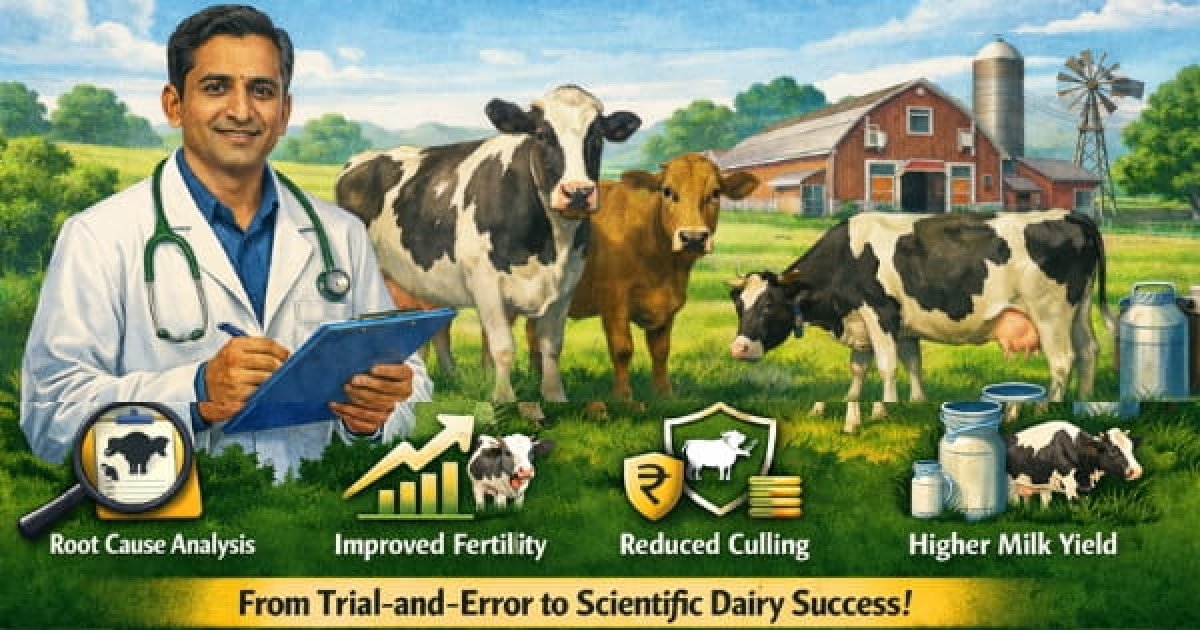

Structured Veterinary Management for Profitable Dairy Farming | Pashupalan
Learn why structured veterinary management is essential for profitable dairy farming. Avoid trial-and-error treatments, improve fertility, increase profit
Why Structured Veterinary Management is Essential in Dairy Farming
Now is the time to move beyond Trial-and-Error and adopt Cause-Based Scientific Livestock Management
India is the largest milk producer in the world. Yet, the ground reality of rural dairy farming is that most cows and buffaloes are still being managed without any scientific system. Decisions related to treatment, breeding, nutrition, vaccination and deworming are often based on “what worked last time” rather than on proper diagnosis. This Trial-and-Error based practice sometimes gives short-term relief, but it always causes long-term losses.
Today, dairy farmers are struggling mainly with three major problems:
- Cows repeatedly falling sick
- Failure to conceive even after repeated inseminations
- Low milk yield, increasing treatment cost and early disposal of animals
The root cause behind all these problems is one — Trial-and-Error based dairy management. Now the time has come to shift dairy farming to a Structured Veterinary Management System.
What is the Trial-and-Error Model?
In most villages the usual treatment pattern is:
- If milk decreases → Give tonic
- If feed intake reduces → Give fever medicine
- If animal does not conceive → Inject hormones
- If udder swells → Use antibiotics
This is not real treatment — it is only guesswork. And a dairy farm that runs on guesswork can never become sustainable. These methods suppress symptoms but leave the real disease untreated. The real causes like nutritional imbalance, mineral deficiency, uterine infections and metabolic disorders continue to damage the animal from inside.
What is Structured Veterinary Management?
Structured dairy management means creating a scientific profile of every cow and making all treatment, feeding and breeding decisions on the basis of recorded data.
Every cow should have its own scientific profile:
- Age and breed
- Previous calving history
- Number of inseminations
- Milk production chart
- Body condition score
- Nutritional chart
- Disease and treatment record
- Mineral and reproductive status
This is called Root-Cause Based Management.
1) It Eliminates Trial-and-Error Treatments
When proper records are available, veterinarians treat animals by identifying causes rather than by guessing.
| Problem | Trial Model | Structured Model |
|---|---|---|
| Low milk yield | Tonic | Nutritional analysis |
| Not conceiving | Hormones | Mineral profiling |
| Repeated illness | Antibiotics | Immunity mapping |
This results in less medicine, better response and lower expenses.
2) It Identifies Root Causes and Enables Targeted Interventions
More than 90% of repeat breeder cows suffer from hidden deficiencies of phosphorus, copper, zinc, selenium and vitamins A & E. But without systematic diagnosis these deficiencies are never corrected. In structured management, deficiencies are corrected first and hormones are kept as the last option.
3) It Reduces Unnecessary Culling and Improves Herd Longevity
Today nearly 30–35% cows are culled only because they are considered “non-productive”. Under structured systems, more than 80% of such cows can be recovered, saving replacement cost and preserving valuable genetics.
4) It Brings Revolution in Reproductive Performance
| Parameter | Unstructured | Structured |
|---|---|---|
| AI per conception | 3–6 | 1–2 |
| Calving-to-conception interval | 200–300 days | 90–120 days |
| Pregnancy loss | High | Low |
| Calf quality | Poor | Strong |
5) It Directly Improves Farm Profitability
| Parameter | Without System | With System |
|---|---|---|
| Annual veterinary cost | ₹35,000 | ₹15,000 |
| Milk production | 100% | 130–150% |
| Replacement cost | High | Almost zero |
| Net profit | Low | 2–3 times higher |
6) It Improves Animal Welfare and Sustainability
Use of painful hormonal injections and unnecessary antibiotics reduces significantly. Animals stay healthier, calmer and productive for longer periods. This becomes the foundation of sustainable dairy farming.
9) Conclusion
The greatest need in animal husbandry today is to move away from guesswork and adopt a systematic approach. Trial and error might work for a while, but it doesn't lead to a sustainable dairy operation. Adopting Structured Veterinary Management results in:
- Reduced trial-and-error treatments
- Targeted interventions based on identifying the root cause
- Reduced unnecessary culling and increased herd longevity
- Improved reproductive performance (fewer artificial inseminations, fewer empty days)
- Strengthened profitability, animal welfare, and sustainability
In the next installments of this series, we will bring you four extremely useful and practical blogs.
You can read these articles on the website and transform your dairy farm into a "systematic dairy farm" step-by-step:- 1) How to create a Structured Farm Profile? — Profile of each cow, register format, what to write, and how to use it
- 2) How to do Mineral Mapping? — Signs of mineral deficiency, correct quantity, quality, and an easy "mineral plan" for farmers
- 3) Model for improving Repeat Breeders in 90 days — Complete protocol for BCS, nutrition, infection control, heat timing, and follow-up
- 4) Practical Dairy System at the Village Level — Daily/weekly routine for small farmers, vaccination-deworming calendar, and "low cost - high impact" management
Stay tuned to Pashupalan.co.in — because the upcoming articles will not just be for reading, but for direct implementation. When farmers have a system, there will be no confusion in treatment, no losses in artificial insemination, and no uncertainty in dairy farming.
Dr. Mukesh Swami
Retired Senior Veterinary Officer
RVC Registration No. 2139