Modern methods of animal husbandry in desert regions
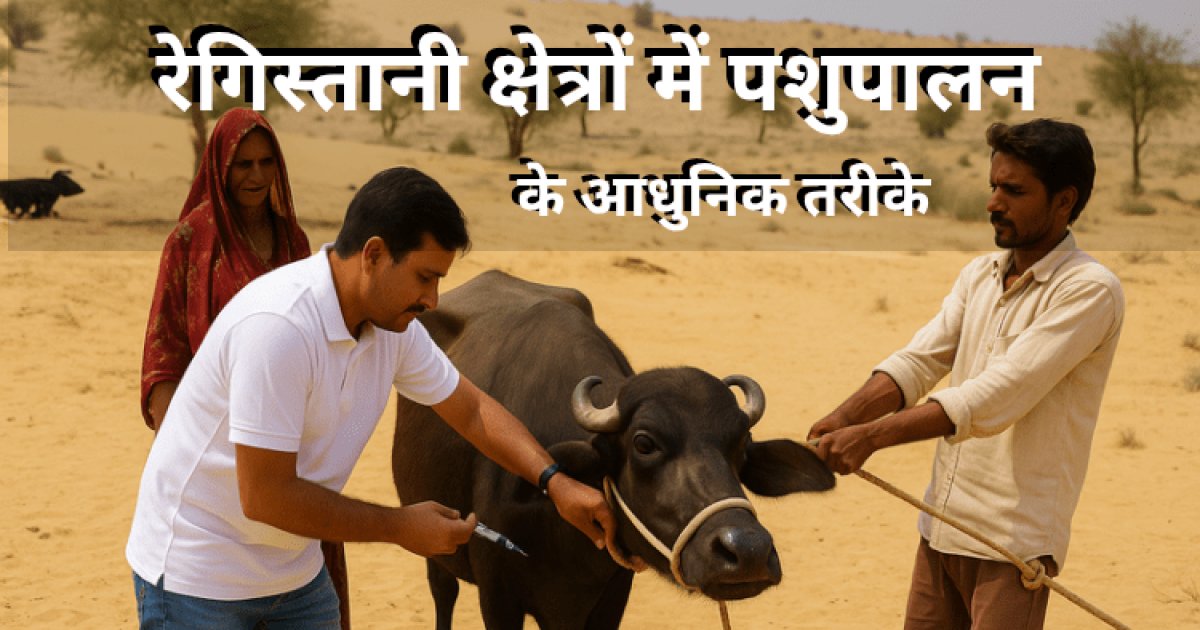

Modern Livestock in Desert Areas
How to practice animal husbandry in desert areas: Breeds like Tharparkar, Rathi, Sirohi, and Punganur; hydroponic fodder; solar equipment; mobile veterinary services; and government schemes.
Livestock farming in desert regions is not just a tradition, but an integral part of life. In the arid areas of Rajasthan, Gujarat, and Haryana, where rainfall is limited and temperatures are extreme, livestock farming sustains the rural economy. Today, modern technology and government schemes have opened up new possibilities for livestock farmers in this region.
1️⃣ Challenges of Livestock Farming in Desert Regions
- Water Scarcity: Low water availability in desert areas makes it difficult for livestock to access drinking water and for fodder production.
- Fodder Shortage: Dependence on rain-fed agriculture results in limited availability of fodder.
- Temperature Effects: Temperatures rising above 45°C in summer and dropping to 5°C in winter cause heat stress in animals.
- Diseases and Parasites: Diseases like Foot-and-Mouth Disease (FMD), Haemorrhagic Septicaemia (HS), and Black Quarter (BQ) are prevalent in the dry and hot environment.
2️⃣ Suitable Breeds for Desert Conditions
Only those breeds that can perform well with less fodder and water can survive in the desert climate. The major breeds of Rajasthan are as follows —
- Tharparkar Cow: Suitable for both milk and work; highly heat tolerant.
- Rathi Breed: A major milk breed of northern Rajasthan; Average milk yield: 8–10 liters.
- Marwari breed: A hardy breed from desert regions, used as pack animals (camels or oxen).
- Sirohi goat: Fast-growing and famous for meat production.
- Punganur cow: India's smallest breed; requires less fodder and water, and produces high-fat milk (8–12%). In desert areas, it is now being used in cross-breeding with Tharparkar or Rathi breeds.
3️⃣ Modern Technologies Transforming Animal Husbandry
- Hydroponic fodder production: 100–200 kg of green fodder can be grown daily in a 1×1 meter room. Only water is sprayed – no soil is needed.
- Solar-powered dairy equipment: Solar-powered milking machines, coolers, and water pumps are useful for rural dairies.
- Mobile veterinary service (1962): Veterinarians reach the village with their vehicle upon a simple call.
- Artificial Insemination (AI): Free service for breed improvement; improved breeds lead to increased milk production.
- Moisture-conserving animal shelters: Sheds made of sand-bricks, tiles, or mud-bricks maintain the temperature at 8–10°C.
4️⃣ Innovative Models for Fodder Production
Fodder production is a major challenge in desert areas. Modern technologies can help solve this:
- Moringa (Drumstick tree) fodder: Rich in protein (25–28%); remains green even in drought.
- Azolla cultivation: A fern-like plant grown in water; Increases milk production by 10–15%.
- Napier (Super Napier) Grass: Yields up to 250–300 quintals per bigha annually.
- Silo Pit Technology: Green fodder can be preserved for 3–6 months by preventing spoilage.
5️⃣ Government Schemes Helping Desert Livestock Farmers
- National Livestock Mission (NLM): Up to 50% subsidy for establishing livestock farming enterprises. Online Application
- Feed and Fodder Development Scheme: Subsidies on fodder seeds, tube wells, and feed units.
- Rajasthan Gopalan Grant Scheme: Financial assistance to cow shelters and cow caretakers.
- Free Vaccination Campaign: Regular vaccination against diseases like FMD, HS, BQ, PPR, etc.
- Free Artificial Insemination Scheme: Free service by trained paravets; resulting in the birth of improved calves.
6️⃣ Modern Dairy Management Tips for Desert Livestock Farmers
- Provide shade and clean water to animals morning and evening.
- Change milking time during summer (early morning, late evening).
- Add mineral mix and jaggery to animal feed.
- Install coolers or ventilation fans to reduce heat stress.
- Maintain complete records of vaccination and artificial insemination.
7️⃣ Lessons from Successful Livestock Farmers
Several livestock farmers in Bikaner district have reduced the cost of milk collection and cooling using solar-powered "mini-dairy units." A young livestock farmer in Jodhpur set up a hydroponic unit in 300 square feet and produced 150 kg of green fodder daily. These examples show that profitable livestock farming is possible even in the desert by combining modern technology and local experience.