New schemes to increase income for livestock farmers in 2025 | Initiatives by the Central and Rajasthan Governments
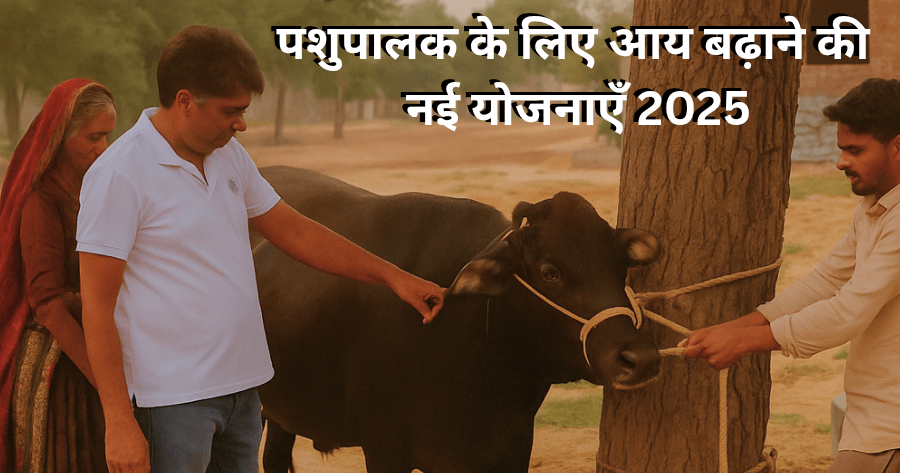
Income-Boost Schemes: 2025
In India, animal husbandry is not only the backbone of the rural economy but also a sustainable source of income for millions of farmers.
In India, animal husbandry is not only the backbone of the rural economy but also a sustainable source of income for millions of farmers. The government aims to ensure that livestock farmers are not limited to just milk or manure, but can double their income through scientific methods and government schemes. The schemes listed below are operated at both the central and Rajasthan state government levels, helping to improve the economic condition, livestock health, and production capacity of livestock farmers.
1️⃣ National Livestock Mission (NLM)
What it is: The National Livestock Mission is a flagship scheme of the Government of India, launched in 2014 and restructured in 2021. Its objective is to diversify livestock production, develop fodder resources, promote entrepreneurship, encourage goat, sheep, and poultry farming, and make livestock farmers self-reliant.
Benefits: This scheme provides subsidies of up to 50%. Livestock farmers can establish livestock units individually, through Self-Help Groups (SHGs), or Farmer Producer Organizations (FPOs). The scheme includes components such as goat farming, pig farming, poultry farming, feed units, hatcheries, and mini-dairies.
How to apply:
1. Visit the official website https://nlm.udyamimitra.in.
2. Fill out the “Pre-Application Form”.
3. The subsidy is approved after verification and approval by the bank/financial institution.
4. Keep all scheme documents (Aadhaar card, bank details, land/lease papers, DPR report) ready.
Tip: It is beneficial to consult the nearest Animal Husbandry Department or District Industries Centre before applying.
2️⃣ Dairy Entrepreneurship Development Scheme (DEDS)
What it is: This scheme is implemented through NABARD.
The objective is to increase self-employment opportunities in the dairy sector and establish modern milk processing units. Benefits: Farmers receive a subsidy of up to 25% (33% for women/SC-ST). The scheme includes dairy farming, milk cooling units, mini dairy plants, fodder storage, and animal transport facilities. How to Apply: 1. Contact your bank branch (affiliated with NABARD). 2. Fill out the DEDS application form and submit it along with the DPR (Detailed Project Report). 3. After approval by the bank, the subsidy is directly credited to your account. Tip: A farm with 2-10 cows/buffaloes is sufficient for the initial stage of this scheme.3️⃣ Livestock Insurance Scheme
What it is: This scheme aims to provide financial security to livestock owners in case of animal death or accident.
Benefits: The state/central government provides up to 50% premium subsidy on the insurance of selected animals.
How to Apply: 1. Contact the nearest animal husbandry office or authorized insurance company. 2. Submit the animal's photograph, identification tag, bank passbook, and health certificate. 3. After receiving the insurance policy, it is necessary to report the death within 24 hours to claim the insurance. Tip: Attaching vaccination records with the insurance simplifies the claim process.
4️⃣ Free Artificial Insemination (AI) Program
What it is: This free artificial insemination service is being run by the state government to improve livestock breeds.
This service is available at the village level through trained para-veterinarians or veterinarians. Benefits: Improved breed of calves, increased milk production, and enhanced disease resistance. How to identify signs of heat (estrus):- The cow or buffalo moos frequently and appears restless.
- Transparent discharge comes from the genitals.
- The animal eats less or exhibits mounting behavior.
5️⃣ National Vaccination Campaign (FMD, HS, BQ, Brucellosis, PPR)
What it is: Free vaccination is provided across the country under the "National Animal Disease Control Programme" (NADCP) run by the Central and State Governments.
Vaccination Schedule:
- FMD – Booster every 6 months.
- HS – Once a year (before the rainy season).
- BQ – Once a year.
- PPR (Sheep and Goats) – Once at 3 months of age.
How to get vaccinated: Contact your village's vaccination camp or veterinary hospital. Keep the animal identification slip safe.
6️⃣ Rajasthan Cow Rearing Grant Scheme
What it is: Financial assistance provided by the Government of Rajasthan to registered cow shelters or cow welfare organizations for animal care and infrastructure development.
Benefits: A fixed amount is provided per animal for fodder, water, treatment, and shelter.
How to apply: Submit the proposal and registration documents to the concerned District Animal Husbandry Office.
7️⃣ Livestock Free Health Scheme
What it is: A state scheme to provide free medicines and treatment to livestock owners in rural areas.
How to avail: Visit the nearest veterinary hospital and register your name and animal details.
8️⃣ 1962 Mobile Veterinary Service
What it is: Mobile veterinary services provided on call to livestock owners.
The mobile veterinary unit reaches the village and treats the animal.How to avail: Call 1962, describe the animal's problem, and the team will reach your location directly.
9️⃣ Feed and Fodder Development Scheme
What it is: Subsidy for the production of nutritious fodder for animals and setting up feed processing units.
How to apply: Apply by getting a DPR (Detailed Project Report) prepared through the Agriculture or Animal Husbandry Department. This scheme is jointly implemented by both the central and state governments.
🔟 Application Process (Step-by-Step)
Links for online application:
- National Livestock Mission (NLM): https://nlm.udyamimitra.in
- Dairy Entrepreneurship Development Scheme: https://nabard.org
- Rajasthan Animal Husbandry Department: https://animalhusbandry.rajasthan.gov.in
Offline application: Obtain the form from the nearest veterinary hospital, Panchayat Samiti, or District Animal Husbandry office.
Conclusion
The central and state government schemes in the animal husbandry sector are designed to sustainably increase the income of livestock farmers. These schemes not only improve animal health but also promote employment, self-employment, and village-level development.
If livestock farmers avail themselves of services such as regular vaccination, artificial insemination, and insurance in a timely manner, both their income and security can be ensured. Important Tip: Stay in touch with your Panchayat or District Animal Husbandry Office to receive timely information about any new schemes or assistance programs. Article Source: Based on official websites and recent press releases of the Central and State Animal Husbandry Departments.